
Restaurant Design Trends 2026: Why Miami Already Speaks the New Language
For close to a decade, restaurant design had one unofficial client: the camera. Bright walls, a neon sign with a quotable line, a backdrop built for a nine-second video. It worked until it didn't, because a room built for a photo has nothing left to offer once the photo has been taken.
Restaurant design trends 2026, tracked across industry reporting this year, describe a clear pullback from that approach. The National Restaurant Association's 2026 State of the Restaurant Industry report frames it bluntly: more than seven in ten consumers say they'd eat out more often if they had the disposable income. Demand for real experience already outpaces what most rooms are built to deliver.
For Miami operators, there's a twist. Several of the year's biggest design shifts aren't new here. They're the city's own architectural language.
The room has to hold up after the photo
Trade sources converge on the same description: a move away from flat, sparse minimalism toward spaces that feel layered and lived-in. Wood, linen, and terracotta replace high-gloss surfaces. Acoustic paneling shows up as a decision made alongside the layout, because noise control now reads as a marker of quality.
That's a shift in what expensive looks like. A loud room used to read as energy. In 2026, it reads as a room that didn't budget for comfort.
Biophilic design gets structural
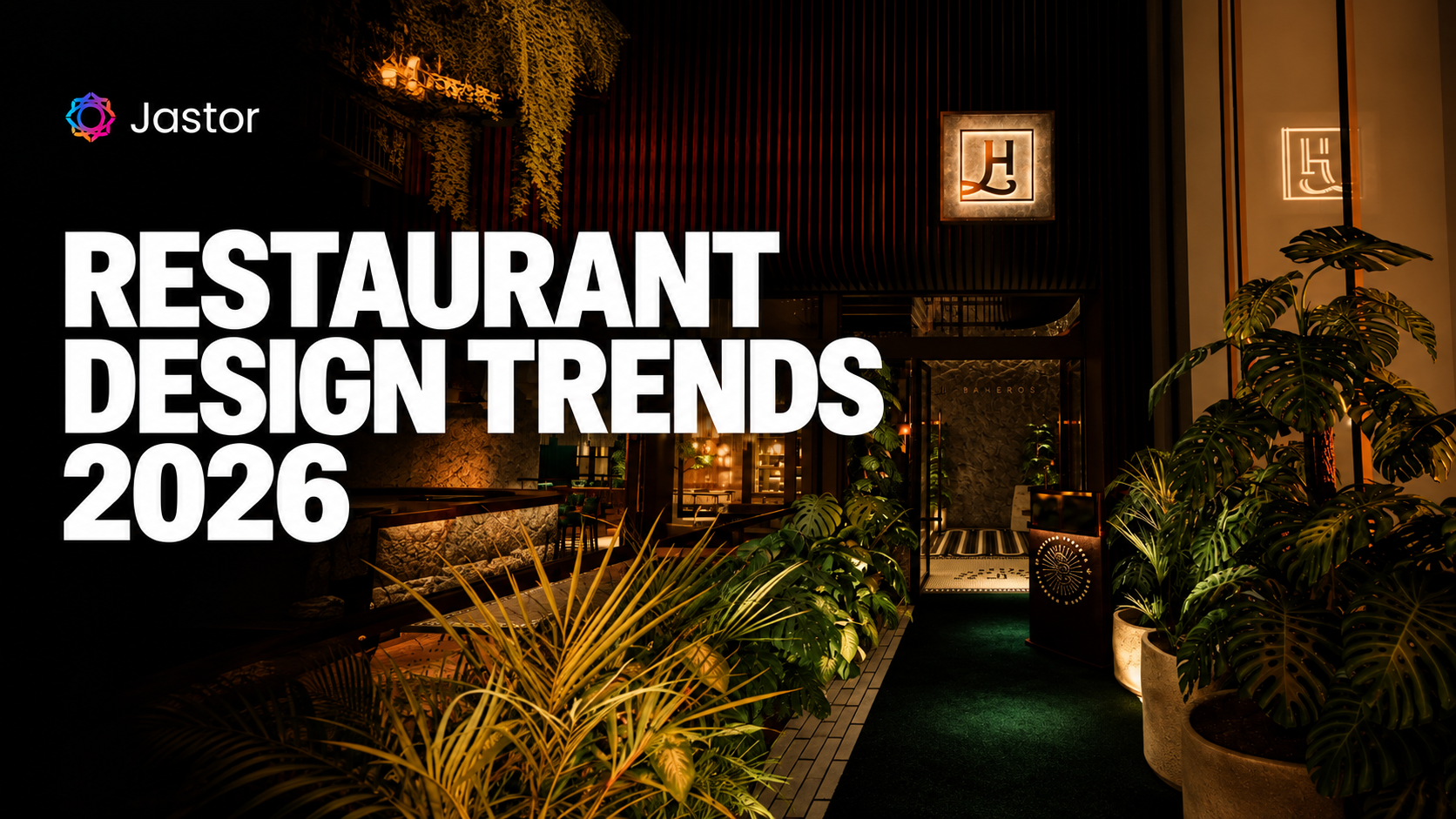
A plant in the corner was never the point. What's changing, per QSR Magazine and other trade reporting, is biophilic design moving into the structure: living walls used as room dividers, interior tree installations that define a zone, moss ceilings over private dining rooms. The plant stops being decoration and starts doing the job a wall used to do.
For a renovation budget, that reframes the spend. The question isn't whether there's money left for greenery. It's whether the layout can use natural material to do work a partition would otherwise do.
Curves return, and Miami restaurant design already speaks that language
Reporting on 2026 design points to arches, curves, and organic forms replacing the hard angles of the last cycle, often described as a nod to Art Deco with a contemporary edge. In Miami, that isn't an imported trend. It's sitting a few blocks away on Ocean Drive.
That's an advantage for local groups if they use it, and a risk if they don't. A Miami concept that ignores this visual language in 2026 is choosing to look imported in a city where the reference already exists for free.
Technology has to disappear into the room
Digital ordering kiosks, table-side QR menus, and connected kitchens are now standard, and the NRA puts AI-driven personalization in the same category: expected infrastructure. When technology is table stakes, it can't be what the room is designed around. A kiosk that dominates an entryway reads as 2019. One that disappears into a well-designed counter reads as 2026.
The same goes for personalization. A recommendation that shows up as a screen popup feels like being sold to. The same recommendation delivered by a server quietly prompted by the system feels like being known.
What restaurant design trends 2026 mean for Miami's F&B industry
• Local identity is a competitive advantage. Curves, warm color, and Art Deco references let a Miami concept argue that it belongs here, which is stronger than simply looking good.
• Acoustics are now part of the price argument. In high-density dining corridors like Brickell and Wynwood, a comfortable sound level supports a higher check.
• Indoor-outdoor living suits structural biophilia. Miami's climate makes living walls and planted zones a natural fit, and they can replace costlier partitions.
• With high rents, the repeat guest is the asset. When rent rises faster than margin, a room designed for the return visit protects revenue better than a room designed for a single post.
The Jastor read
Every one of these shifts points the same way: design in 2026 is judged on how a room feels an hour in, not how it looks in the first fifteen seconds. That's a harder brief than "make it photogenic," and it's the brief Jastor designs for: restaurant interiors built for the return visit.
In Miami, it also connects directly to the business. As we wrote about operators buying their buildings and rent closing Michelin-starred restaurants, the room has to work as a business, not only as a photo.
What to do with this
If a renovation or new build is on the calendar, the test isn't "will this photograph well." It's "will a guest still enjoy sitting here in twenty minutes," with the noise level, the materials, and the technology working for the room.
Jastor designs restaurant interiors in Miami and beyond around that question, together with the brand and the growth strategy behind them. See the approach in our work, or talk to us about your next location. the growth strategy behind them. See the approach in our work, or talk to us about your next location.
Sources
· National Restaurant Association, '2026 State of the Restaurant Industry' — https://restaurant.org/research-and-media/research/research-reports/state-of-the-industry/
· QSR Magazine, 'Restaurant Trends for 2026: Hospitality Reenters the Innovation Cycle' — https://www.qsrmagazine.com/story/restaurant-trends-for-2026-hospitality-reenters-the-innovation-cycle/
· Webstaurantstore, 'Contemporary Restaurant Design Trends for 2026' — https://www.webstaurantstore.com/blog/2374/top-restaurant-design-trends.html
· Katom, 'Top Restaurant Design Trends & Innovations of 2026' — https://www.katom.com/learning-center/restaurant-design-trends.html